What is Flue Gas?
When fossil fuels are burned, waste gases called flue gases are produced. One of the harmful gases in flue gas is sulfur dioxide (SO₂), which causes acid rain.
The process of removing sulfur dioxide from flue gases is called Flue Gas Desulfurisation.
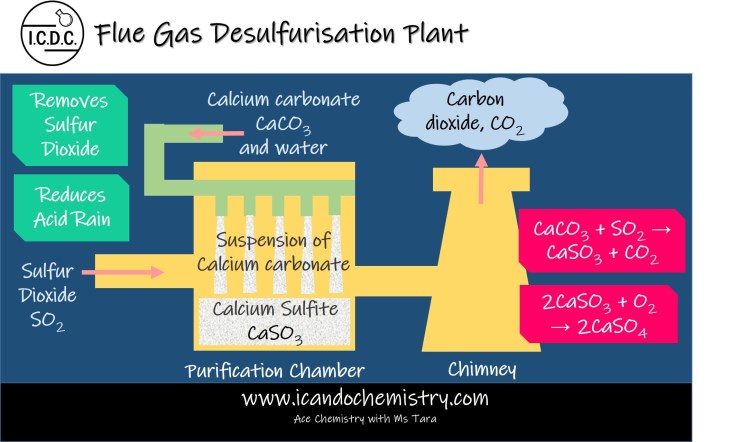
Chemical Reactions in Flue Gas Desulfurisation
Sulfur dioxide is an acidic oxide.
Method 1: Using Calcium Carbonate (CaCO₃)
It is allowed to react with an wet mixture of calcium carbonate to form solid calcium sulfite. Carbon dioxide gas is also formed. Calcium sulfite then further oxidises to calcium sulfate by atmospheric oxygen, which is then dumped.
Equation 1:
CaCO3 (s) + SO2 (g) → CaSO3 (s) + CO2 (g)
Equation 2: (Oxidation)
2CaSO3 (s) + O2 (g) → 2CaSO4 (s)
Method 2: Using Calcium Oxide (CaO / Quicklime)
Alternatively, the acidic sulfur dioxide is allowed to react with basic calcium oxide to form calcium sulfite, which is then oxidised to calcium sulfate.
Equation 1:
CaO (s) + SO2 (g) → CaSO3 (s)
Equation 2: (Oxidation)
2CaSO3 (s) + O2 (g) → 2CaSO4 (s)
Key Summary
- Flue gas desulfurisation reduces air pollution and acid rain.
- Calcium carbonate or calcium oxide is used to neutralise acidic sulfur dioxide gas.
- The final product is calcium sulfate (gypsum), which can be used in the building industry.


 Science with Tara