In this post, we will learn what ions are, how they are formed, and how to determine the number of protons, electrons and neutrons in an ion.
By the end of this article, you will be able to:
- Explain what cations and anions are
- Calculate the number of electrons in an ion from its charge
- Find the number of neutrons using the mass number
What are Ions and How are They Formed?
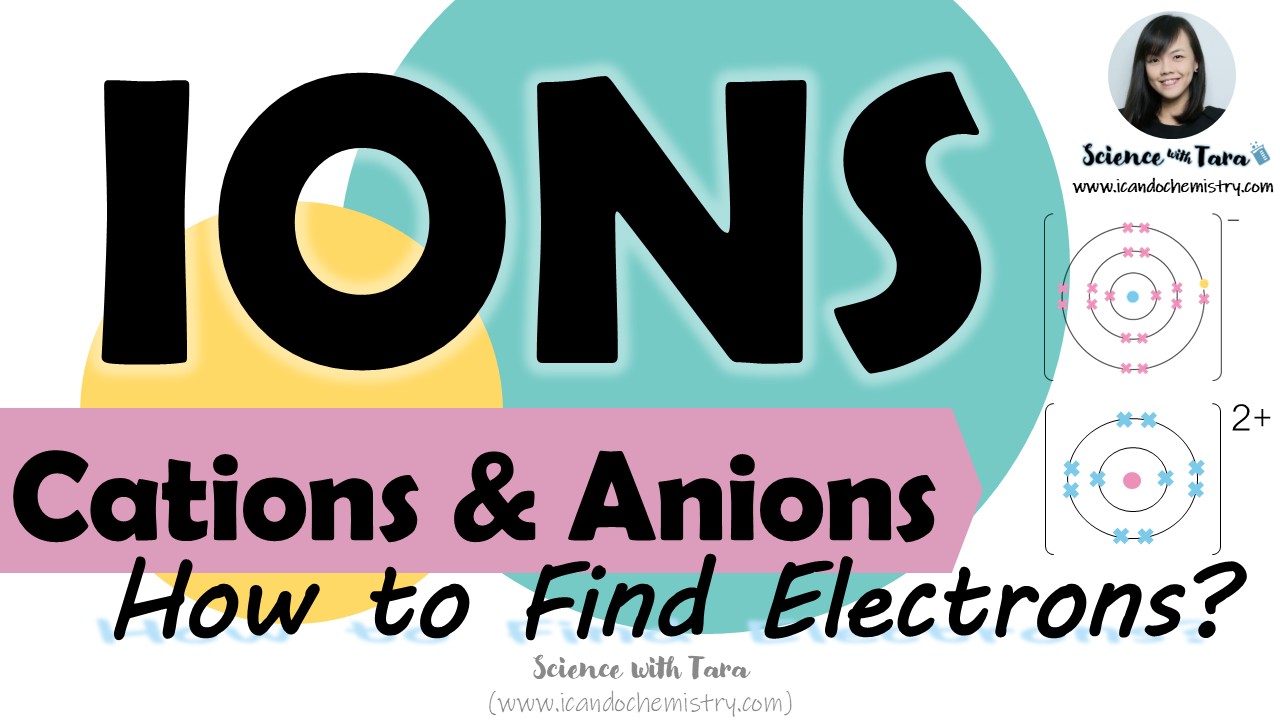
An ion is a charged particle formed when an atom gains or loses one or more electrons.
There are two types of ions:
- Cation – a positively charged ion. It is formed when an atom loses electrons. Metals tend to form cations. (Hydrogen is a non-metal but can also form the positive ion H⁺.)
- Anion – a negatively charged ion. It is formed when an atom gains electrons. Non-metals tend to form anions.

Important points to remember:
- When an atom forms an ion, only the number of electrons changes.
- The number of protons and neutrons stays the same. This is because protons and neutrons are located in the nucleus and are not involved in chemical reactions.
How to Calculate the Number of Electrons in an Ion?
Answers and Explanations in this Video: https://youtu.be/7qwT0Sc32f4
Example 1
An atom has a proton number of 17 and 18 neutrons. It forms an ion with a charge of –1. Determine the number of protons, neutrons and electrons in this ion.

Example 2
An atom has 12 protons and 12 neutrons. It forms an ion with a charge of +2. Determine the number of protons, neutrons and electrons in this ion.


Example 3
A particle has 11 protons, 12 neutrons and 10 electrons.
(a) Is this particle an atom or an ion? Explain your answer.
(b) What is the charge of this particle?
(c) Write its nuclide notation.
(d) Explain why the number of protons and neutrons did not change when the atom formed an ion.
Practice Questions
Find the number of protons, electrons and neutrons for the following ions:

Answers and Explanations in this Video: https://youtu.be/7qwT0Sc32f4
How to work out the answers:
- Protons → Look up the proton number of the element from the Periodic Table.
- Electrons → Look at the charge of the ion.
- Positive charge → electrons are lost
- Negative charge → electrons are gained
- Neutrons → Mass number – Proton number
Summary
- An ion is a charged particle formed when an atom gains or loses electrons.
- Cations are positive (formed by loss of electrons).
- Anions are negative (formed by gain of electrons).
- Only the number of electrons changes when an ion is formed.
- Protons and neutrons remain the same.
- Neutrons = Mass number – Proton number


Learn more…
Previous lesson: How to Write Nuclide Notation of Atoms
Next lesson: Why do atoms form bonds?
All topics: Chemistry Resources