What are Alkenes?
Alkenes are a homologous series of unsaturated hydrocarbons with the general formula CnH2n.
All alkenes contain the carbon-carbon double bond (C=C). This double bond is very reactive, hence, alkenes undergo addition reactions readily.
In an addition reaction, the C=C double bond breaks and becomes a single bond. The unsaturated hydrocarbon becomes a saturated hydrocarbon.
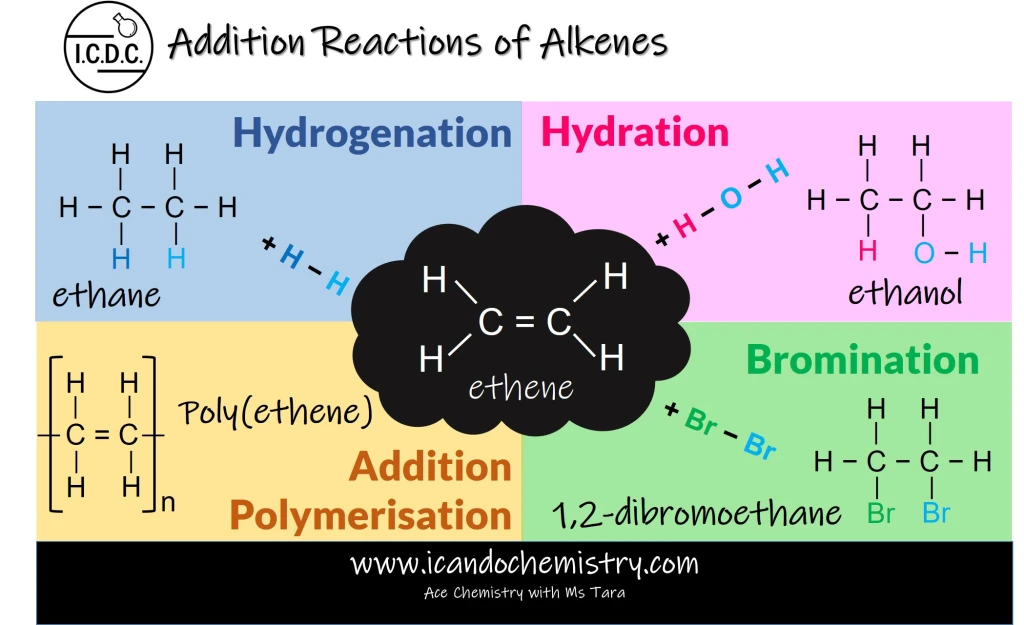
Main Addition Reactions of Alkenes
1. Hydrogenation
Hydrogenation is the addition of hydrogen to alkenes to form alkanes.
- Reaction: Alkene + Hydrogen → Alkane
- Conditions: 200°C, nickel catalyst
- Purpose: Used to convert unsaturated oils into saturated fats (e.g. margarine production)
2. Hydration
Hydration is the addition of steam to alkenes to form alcohols.
- Reaction: Alkene + Steam → Alcohol
- Conditions: 300°C, 60 atm pressure, phosphoric(V) acid catalyst
- Example: Ethene + Steam → Ethanol
3. Bromination (Test for Unsaturation)
Bromination is the addition of bromine to alkenes.
- Reaction: Alkene + Bromine → Dibromoalkane
- Observation: Reddish-brown bromine water decolourises (turns colourless)
- Use: This is a common chemical test to detect the presence of alkenes (unsaturated hydrocarbons).
4. Addition Polymerisation
Addition polymerisation is the reaction between alkenes to form addition polymer.
- Many alkene molecules join together to form a long-chain addition polymer.
- Conditions: High temperature, high pressure, and a catalyst.
- Example: Many ethene molecules → Poly(ethene) / Polythene


 Science with Tara