Qualitative Analysis is the process of identifying unknown cations in solution. In O-Level and IGCSE Chemistry, you are expected to use aqueous sodium hydroxide and aqueous ammonia to identify common cations.
Syllabus Objectives:
Describe the use of aqueous sodium hydroxide and aqueous ammonia to identify the following aqueous cations: aluminium, ammonium, calcium, copper(II), iron(II), iron(III), lead(II) and zinc (formulae of complex ions are not required).
Cation Tests and Observations
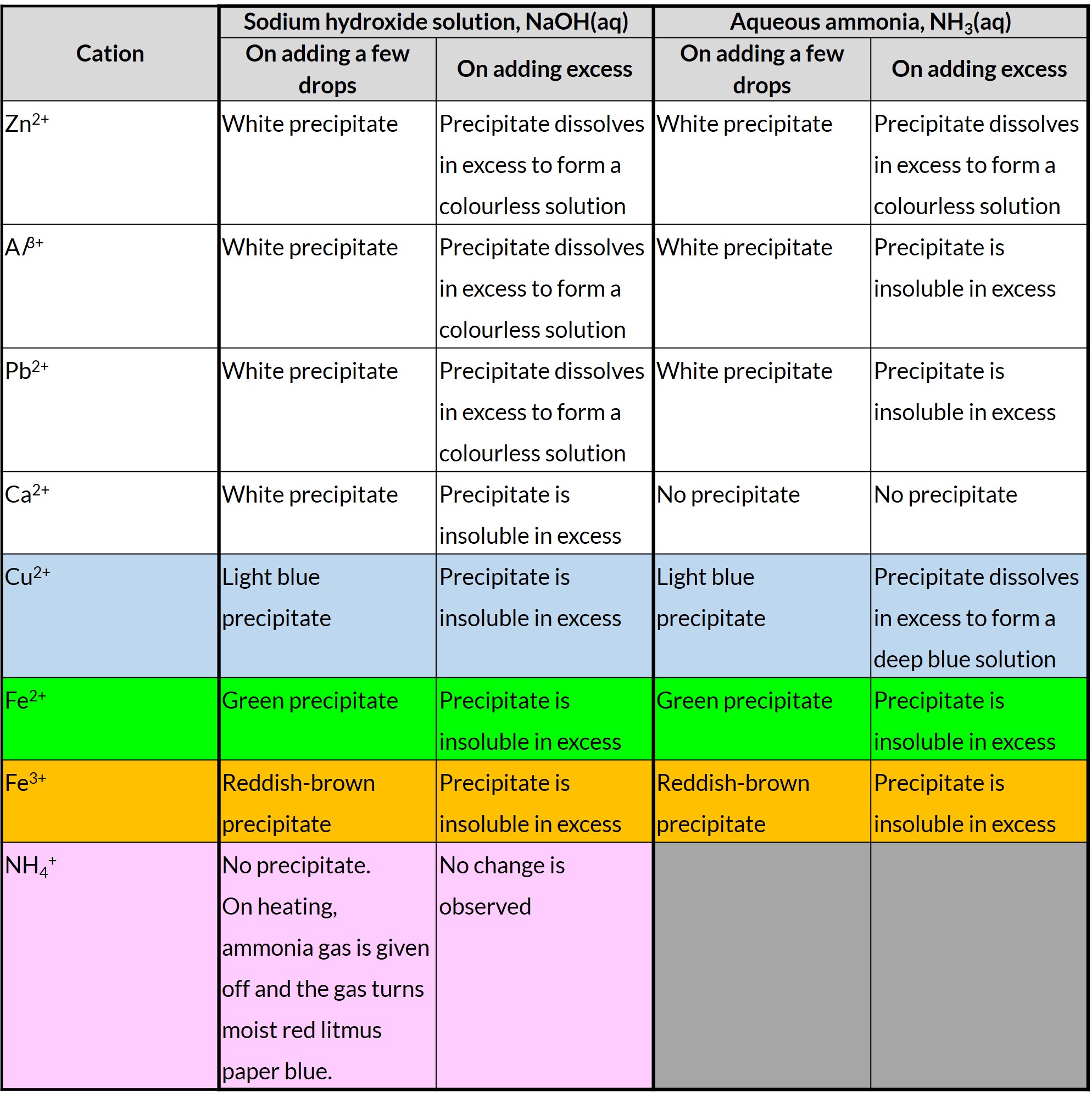
Reaction with Aqueous Sodium Hydroxide, NaOH (aq)
Outcome 1: No precipitate formed (NH4+)
Ammonium salts will react with aqueous sodium hydroxide to form a soluble salt, water and ammonia gas.
Example: Ammonium chloride + Sodium Hydroxide → Sodium Chloride (soluble) + Water + Ammonia gas
Chemical Equation: NH4Cl (aq) + NaOH (aq) → NaCl (aq) + H2O (l) + NH3 (g)
On heating, ammonia gas is given off. Gas turns moist red litmus paper blue.
Question: Why should the litmus paper be moist?
Ammonia, being an alkaline gas, produces hydroxide ions (OH–) in the presence of water.
Chemical Equation: H2O (l) + NH3 (g) → NH4+ (aq) + OH– (aq)
Outcome 2: Precipitate formed (Zn2+, Al2+,Pb2+,Fe2+,Fe3+,Cu2+,Ca2+)
When sodium hydroxide is added to other metal cations, an insoluble hydroxide is formed.
Example 1:
Lead(II) chloride + Sodium Hydroxide → Lead(II) Hydroxide (insoluble) + Sodium Chloride (soluble)
Chemical Equation: PbCl2 (aq) + 2 NaOH (aq) → Pb(OH)2 (s)+ 2 NaCl (aq)
White precipitate of lead(II) hydroxide is formed.
Example 2:
Iron(II) nitrate + Sodium Hydroxide → Iron(II) Hydroxide (insoluble) + Sodium Nitrate (soluble)
Chemical Equation: Fe(NO3)2 (aq) + 2 NaOH (aq) → Fe(OH)2 (s)+ 2NaNO3 (aq)
Green precipitate of iron (II) hydroxide is formed.
Reaction with aqueous ammonia
Outcome 1: No precipitate formed (Ca2+)
No precipitate is formed as there is little amount of hydroxide ions present to form precipitate with calcium hydroxide, which is partially soluble.
Note: Aqueous ammonia is a weak alkali and produces only a low concentration of hydroxide ions.
Outcome 2: Precipitate formed (Zn2+, Al2+,Pb2+,Fe2+,Fe3+,Cu2+)
When aqueous ammonia is added to other metal cations, an insoluble hydroxide is formed.
Example 1:
Copper(II) chloride + Aqueous Ammonia → Copper(II) Hydroxide (insoluble) + Ammonium Chloride (soluble)
Chemical Equation: CuCl2 (aq) + 2 NH4OH (aq) → Cu(OH)2 (s)+ 2 NH4Cl (aq)
Light blue precipitate of copper (II) hydroxide is formed.
Example 2:
Zinc nitrate + Aqueous Ammonia → Zinc Hydroxide (insoluble) + Ammonium Nitrate (soluble)
Chemical Equation: Zn(NO3)2 (aq) + 2 NH4OH (aq) → Zn(OH)2 (s)+ 2 NH4NO3 (aq)
White precipitate of zinc (II) hydroxide is formed.
Special note for Zn²⁺: White precipitate dissolves in excess ammonia to form a colourless solution.
How to Distinguish Pb²⁺ from Al³⁺
Lead(II) ions and aluminum ions give the same results in both aqueous sodium hydroxide and aqueous ammonia. How do we distinguish lead(II) ions from aluminium ions?
Answer
Test: Add any solution containing chloride ions (e.g. NaCl) or sulfate ions (e.g. Na2SO4). Only lead(II) ions give white precipitate with chloride ions (or sulfate ions).
Pb²⁺: White precipitate forms
Al³⁺: No precipitate forms
Summary & Key Takeaways
- Use NaOH and NH₃ to identify cations based on precipitate formation and colour.
- Zn²⁺ is the only cation whose precipitate dissolves in excess NH₃.
- Use chloride or sulfate test to distinguish Pb²⁺ from Al³⁺.


 Science with Tara